
![]() by Adam Hedges, Photographs by Shane Hedges
Bio Boundaries
Tourists visit Botswana predominantly to experience the thrill of viewing wild animals in their natural habitat. Although the Swahili word “safari” originated in East Africa, there is no doubt that places with names such as Okavango, Kalahari, Moremi and Chobe, evoke images of some of Africa’s finest and most pristine wildlife viewing opportunities.
What is more, discerning adventurers arriving in Botswana are just as excited to find and photograph some of the lesser-known mammals that reside within the country, not just the iconic “Big 5”!
Such a mammal is the African wild dog (Lycaon pictus), or painted dog, Africa’s version of the North American canid, but from whose evolutionary lineage the wild dog diverged some three million years ago.
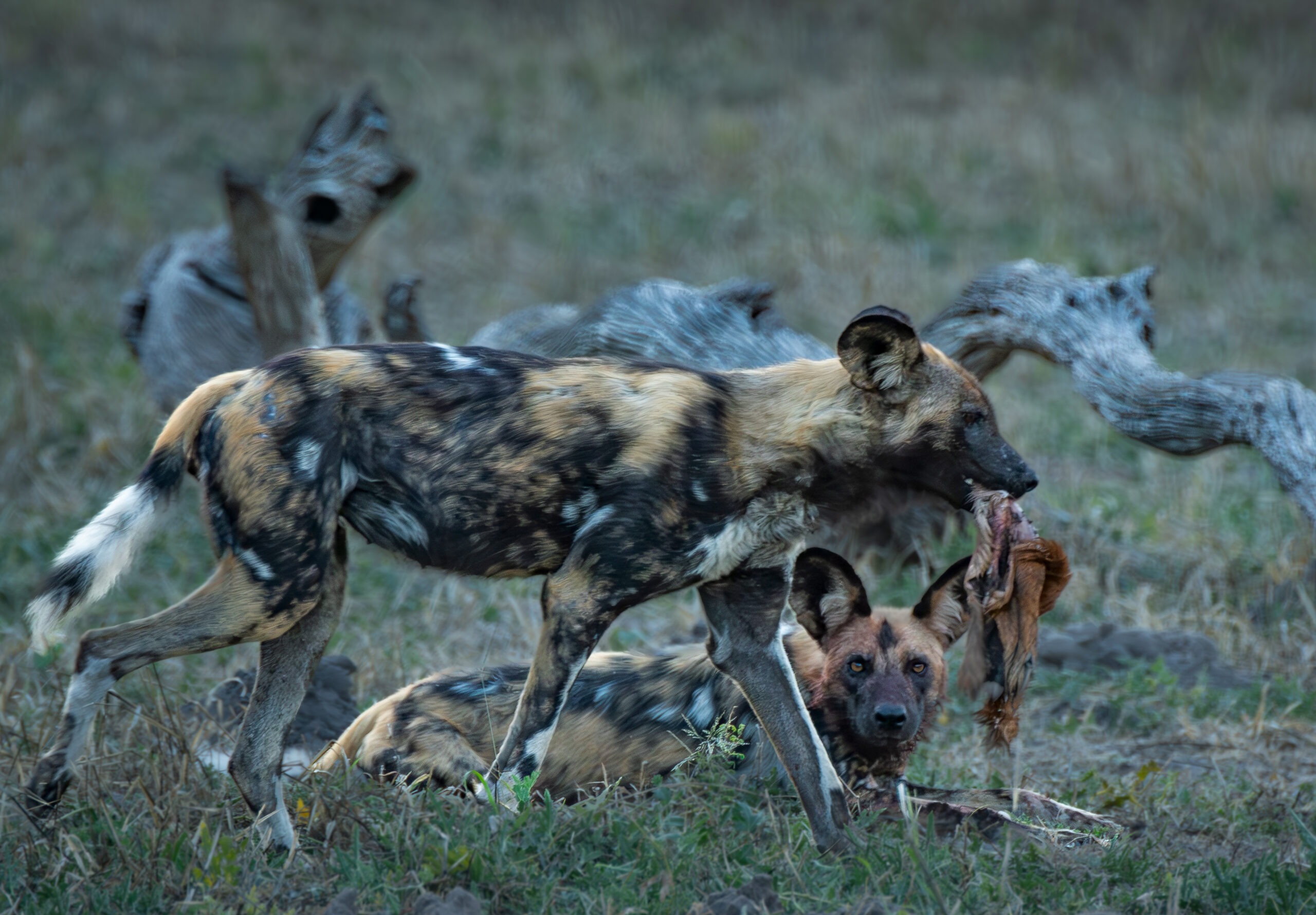
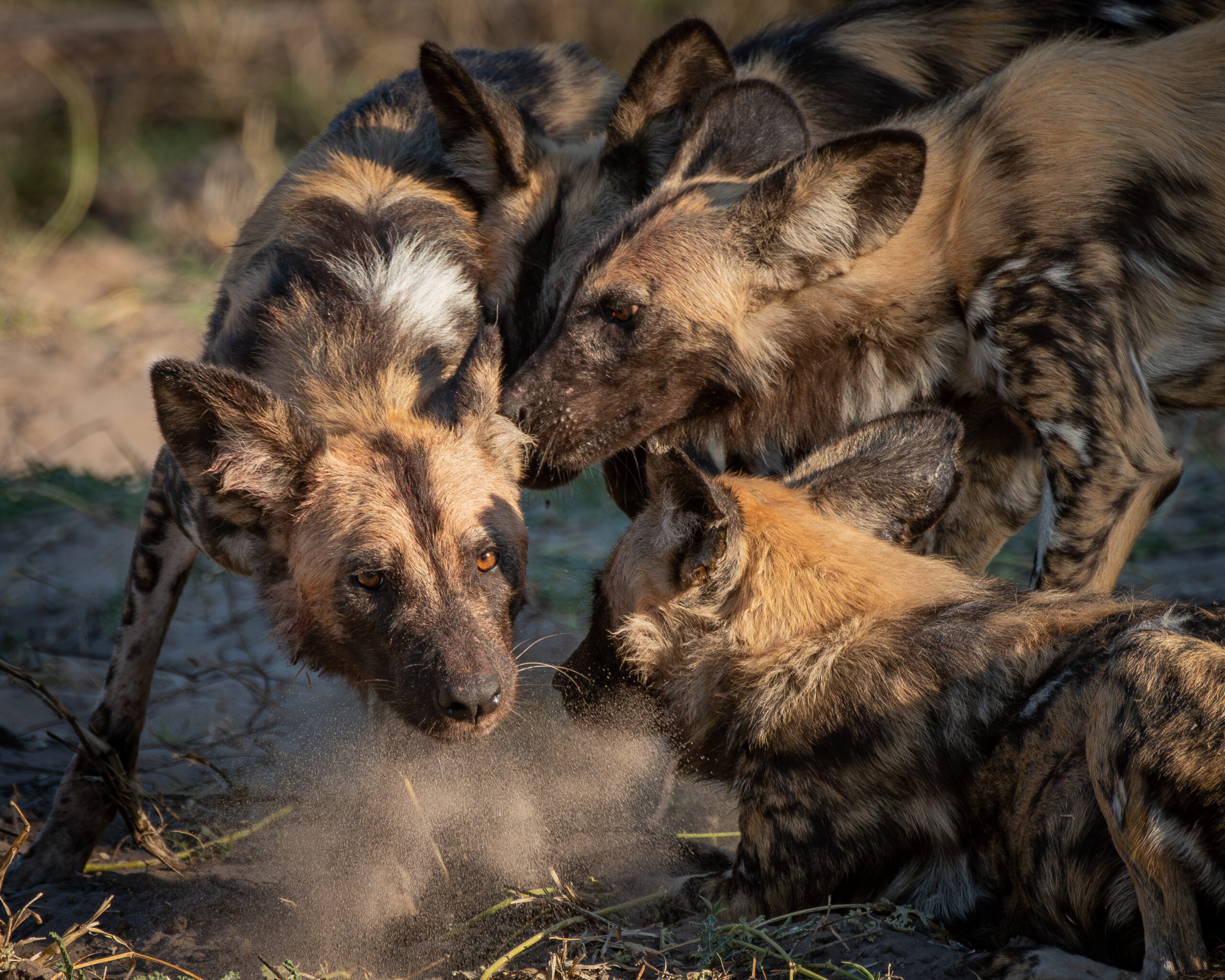
Finding a pack of these animals on a game drive will likely elicit a spike of adrenaline, especially if they are hunting. To witness this cooperative and extremely successful predator at work is to witness nature at her most excoriated. Science has only begun to explore their biology and behavior, much of which is remarkably similar to their North American cousins. A pack is led by an alpha pair, who mate annually and whose pups are reared by the whole pack. Subordinate adults forego reproduction to help raise the young.
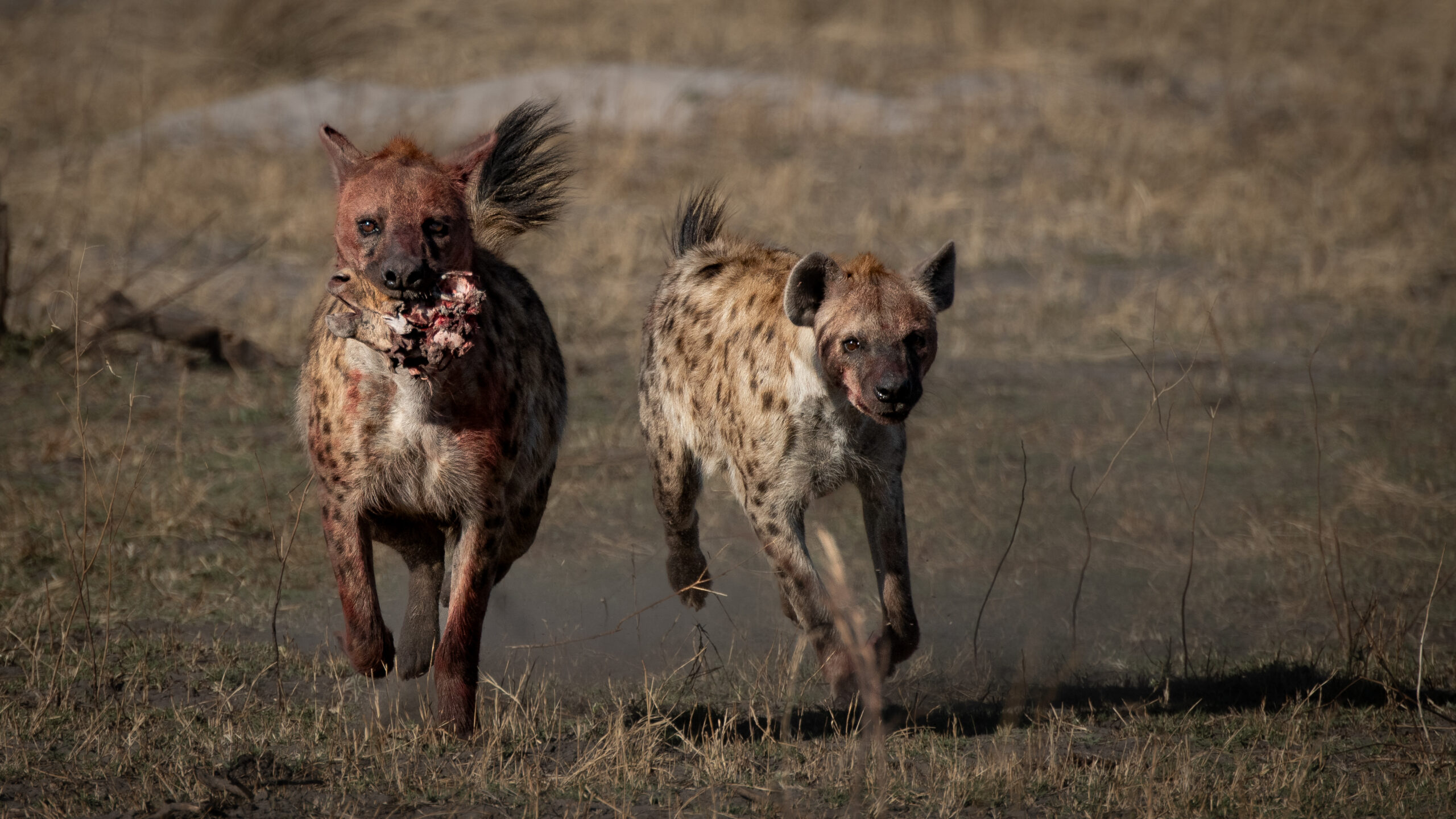
Royal African Partner Shane Hedges, whose images grace this article, witnessed some very unusual behavior on multiple occasions while staying at Mombo in August 2023. A pack of wild dogs seemingly tolerating a clan of spotted hyenas (Crocuta crocuta) resting very close to their den where the alpha female wild dog was ensconced with pups. Once the wild dogs started hunting, as they do morning and evening, the hyena tagged along behind. As soon as the wild dog had made a kill, the hyena would steal it. The wild dogs would then continue hunting until they made a kill that they could feed on in peace. It seemed almost as if, in exchange for leaving the wild dog pups alone, the adults had to pay an impala “tax” to the hyena.
Botswana’s Okavango Delta, proclaimed UNESCO’s 1000th World Heritage Site in 2014, is justifiably the country’s crown jewel as a tourist attraction. But consisting of the only river that flows into the Kalahari, there is increasing competition for its natural resources, which has led to rising human-wildlife conflict.
On the one hand, a myriad of wild animals have existed and migrated into the Okavango for millennia. On the other, human populations need the water for crops and livestock.
Fortunately, a new science is being developed that can mitigate the conflict. Wild Entrust Botswana Predator Conservation’s “BioBoundary” Project is developing new tools to reduce human-predator conflict by reducing predator attacks on livestock and the need for lethal control of predators.
The BioBoundary Project has two main components. Perimeter BioBoundaries that deter predators from leaving protected areas by mimicking scent marks that demarcate home ranges and territories, and BioBoundary repellents that use single components or simple mixtures of components of predator odors to keep carnivores away from livestock.
The science behind this innovative approach to the age-old problem of human-wildlife conflict puts the BioBoundary project in Botswana at the forefront of research into predator deterrent technology worldwide.
The implications are enormous. What started out as a way to protect Africa’s second most endangered carnivore, the wild dog, of which there are estimated to be only 7,000 left in the wild, from extermination by livestock farmers, could very possibly lead to an economically and ecologically sustainable, and therefore infinitely more attractive methods for reducing conflict with a wide range of animals from leopards to elephants.
Imagine: instead of a cattle farmer resorting to killing lions to protect his livestock, for less than the cost of a bullet he can deter lions more effectively by hanging a vial of harmless, odorous liquid on a collar around the neck of a cow. Or a maize farmer could encircle his field with a few vials of liquid that keep out elephants more effectively than hugely expensive electric fences, chilis, or hard-to-maintain beehives. And not just maize farms, villages in remote areas of Botswana that are subject to invasion by elephants could be protected too.
Of course, without more research, none of this will be possible. Scientific discoveries are not made by magic. Proving that scent-based predator deterrents really can protect livestock has taken years of laboratory analysis, field work and tens of thousands of camera trap videos of predators communicating by scent. More investment is still needed to continue the BioBoundary project’s work on keeping Botswana’s African wild dog safe inside protected areas and reducing livestock depredation and human carnivore conflict in livestock areas.
But what if Botswana continues to lead the way in a new conservation practice that is applicable to human predator conflict globally? BioBoundaries could be scaled in two dimensions: in geographic coverage from local to global, and the size of the problem from a single chicken coop to a trans-frontier wildlife corridor.
If you would like to donate to this project to help with this fantastic work, you can do so through our Royal African Foundation.
100% of your donation will go to the project you choose, and your donation to our registered 501(c)(3) organization is tax-deductible as provided for by law.
Please get in touch with us if you have any questions.


The People
The Process
The Journey
The Stories
The Foundation
Contact
North America:1-877-337-4176
International:+1-416-915-4145
- info@royalafrican.com
© 2026 Royal African Safaris
Design and Development by Focus Online