
![]() Did You Know?
The Hippopotamus
Did You Know?
The Hippopotamus
The word “hippopotamus” can be traced back to the combination of two Greek words: “Hippo” meaning “horse,” and“potamos” meaning “river” = River Horse.
There are two types of hippopotamus, the Common and the Pygmy. Once widely found throughout sub-Saharan Africa, the Common Hippo’s range has been reduced and fragmented and both species are mostly confined to protected areas. The Pygmy Hippo is primarily found in the tropical rainforests and swamps of a few countries in West Africa, whereas the Common Hippo is the species you will see while on safari in East and Southern Africa, and which is the focus of this article.
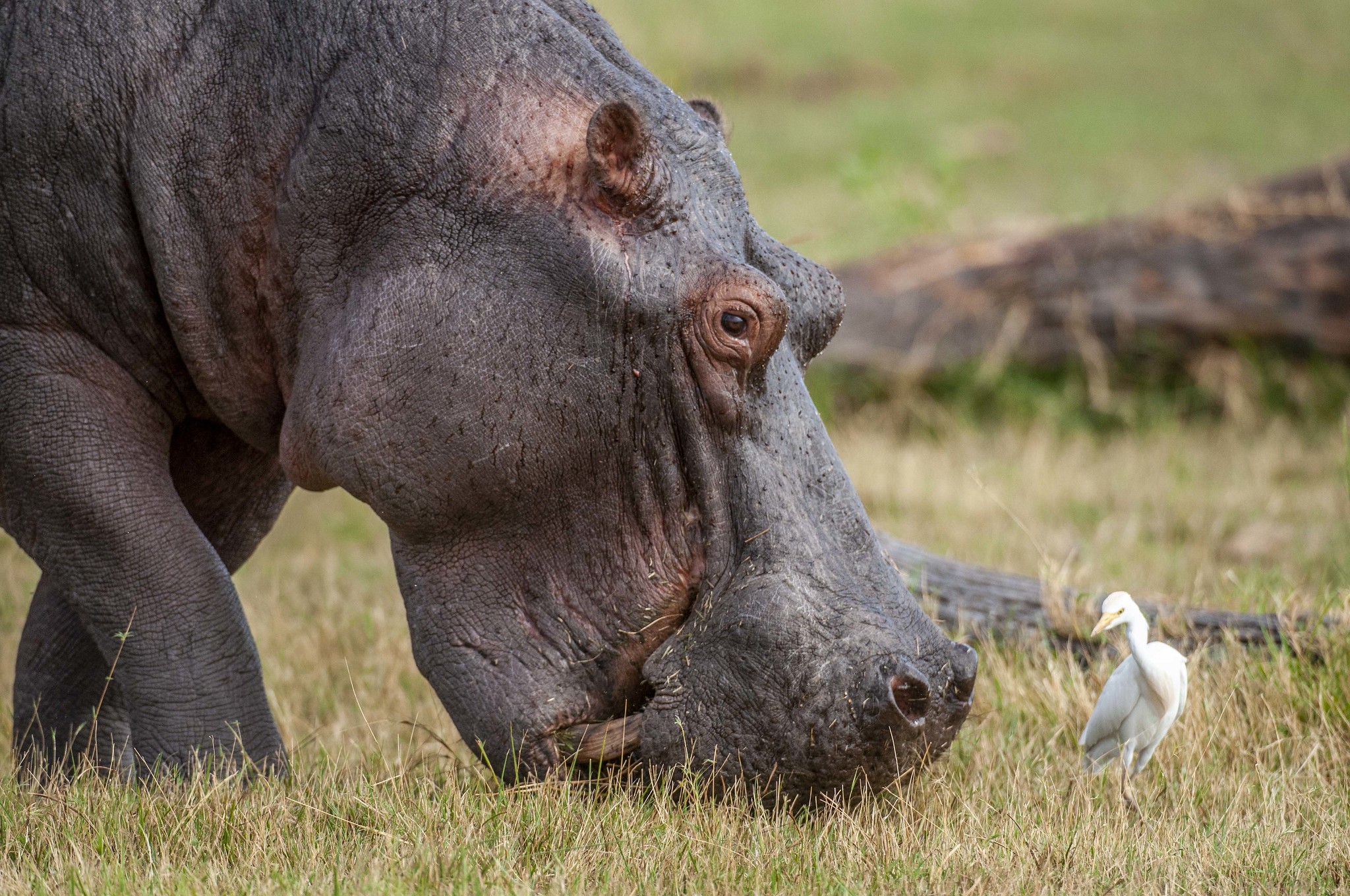
With its head poking above the water – large snout, small ears, and eyes often closed – the hippo can be perceived as “chill” and “cute” as it rests during the day. This could not be farther from fact! It is actually among the most dangerous and aggressive of all mammals and will attack humans who infringe on its territory. Its sharp incisors can grow up to 1.3 feet and its lower canines up to 1.6 ft. and these are used to fight and defend themselves. Their strong jaws can open to 180 degrees and their bite is nearly 3 times stronger than a lion’s!
Hippo are also the third largest land mammal after the elephant and white rhino, with males weighing between 3,500 to 9,920 lbs. and females around 3,000 lbs. Their barrel-like chubby shape is deceptive: they are able to run on land up to 19 mph and can actually sprint at speeds up to 30 mph. Furthermore, they can run underwater at 12 mph – that’s 6 times faster than the speed an average person can swim!
Given that they spend up to 16 hours each day in the water, you would think they are great swimmers but they can’t actually swim or float because their bodies are so dense, nor can they breathe underwater. However, they have adapted to life in the water by walking or standing on the river bottom. And, because their eyes and nostrils are on top of their heads they can still see and breathe while the rest of their body remains submerged. Their nostrils and eyes shut tightly when totally submerged and they can hold their breath for up to five minutes. A very cool adaptation is the fact that while they nap in water during the day, a subconscious reflex pushes them to the surface to breathe without waking them up!
Hippo spend all this time in the water or mud for a reason – to keep them cool and protect their delicate skin. To help them do this, they secrete a reddish oily fluid from glands in their skin which functions as a moisturizer, water repellent and antibiotic.
Hippo are highly social and usually form groups, called a pod or a bloat, of 20-100 individuals. Males and females tend not to socialize and generally remain separated. Males are very territorial and the dominant male reminds other hippos of his territory by flinging his dung as far as possible with his fan-shaped tail!
After the sun sets, the nocturnal hippo leaves the water to graze for up to six hours and while large in size, it only eats an average of 88 lbs of grass which is only about 1-1.5% of its body weight.
So, next time you encounter a hippo, remember this “chill” and “cute” animal can outrun, out swim and easily chomp you in two if provoked!


The People
The Process
The Journey
The Stories
The Foundation
Contact
North America:1-877-337-4176
International:+1-416-915-4145
- info@royalafrican.com
© 2026 Royal African Safaris
Design and Development by Focus Online